




This is a cache of https://www.paroc.com/en/article/fire-resistance-fire-protection. It is a snapshot of the page as it appeared on 2026-04-12T00:18:50.732+0000.
Fire resistance vs fire protection: Everything you need to know about fire-resistant insulation | Paroc Article Skip to main content
Fire resistance vs fire protection – PAROC Vect

Fire resistance vs fire protection: Everything you need to know about fire-resistant insulation

Written By PAROC Technical InsulationDate Published 2026-03-27

Fire safety is a fundamental consideration in building design, requiring careful planning to protect both the structure and the people within it. A key part of this protection involves selecting appropriate materials, especially insulation—which plays a vital role in limiting the spread and impact of fire. This is particularly important for HVAC systems and ductwork that run throughout the building. Choosing the right insulation can mean the difference between containing a fire and allowing it to spread.

Fire resistance focuses on containment, helping to prevent flames and smoke from moving through a building, while fire protection ensures that critical components, such as structural supports, remain operational during a fire.

This article explores the key factors to consider when selecting insulation to support overall fire safety.

Fire safety, fire protection and fire resilience

Fire safety is the overall goal to safeguard against fire. Building standards are closely related to this. Fire protection specifically is what you do to make a building safe from fire. Fire protection measures should:

  • protect a building's occupants and their property
  • minimize damage associated with fire
  • provide ample time for a safe escape from fire
  • limit the risk to firefighters when tackling a fire
  • prevent environmental damage from building fire
  • reduce the risk of building loss or major repairs
  • lower building insurance and property risk from accidental fires, protecting investment and providing longer-term value

The two types of fire protection

There are two key types of fire protection - passive fire protection (PFP) and active fire protection (AFP).

Active fire protection: Consists of fire protection systems that require either automatic or manual activation or operation, in order to detect, control, suppress, or mitigate fire or smoke. Some active solution examples are sensors, alarms, and sprinklers.

Passive fire protection: Measures include structures, layouts, systems and applications which naturally limit fire ignition or spread. PFP is crucial to fire safety and typically forms part of any building’s fire safety design. It focuses on containing and slowing the spread of fire and smoke.

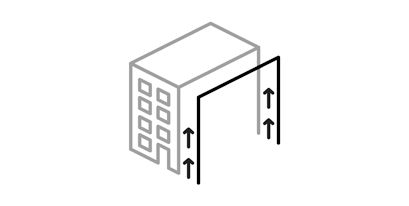
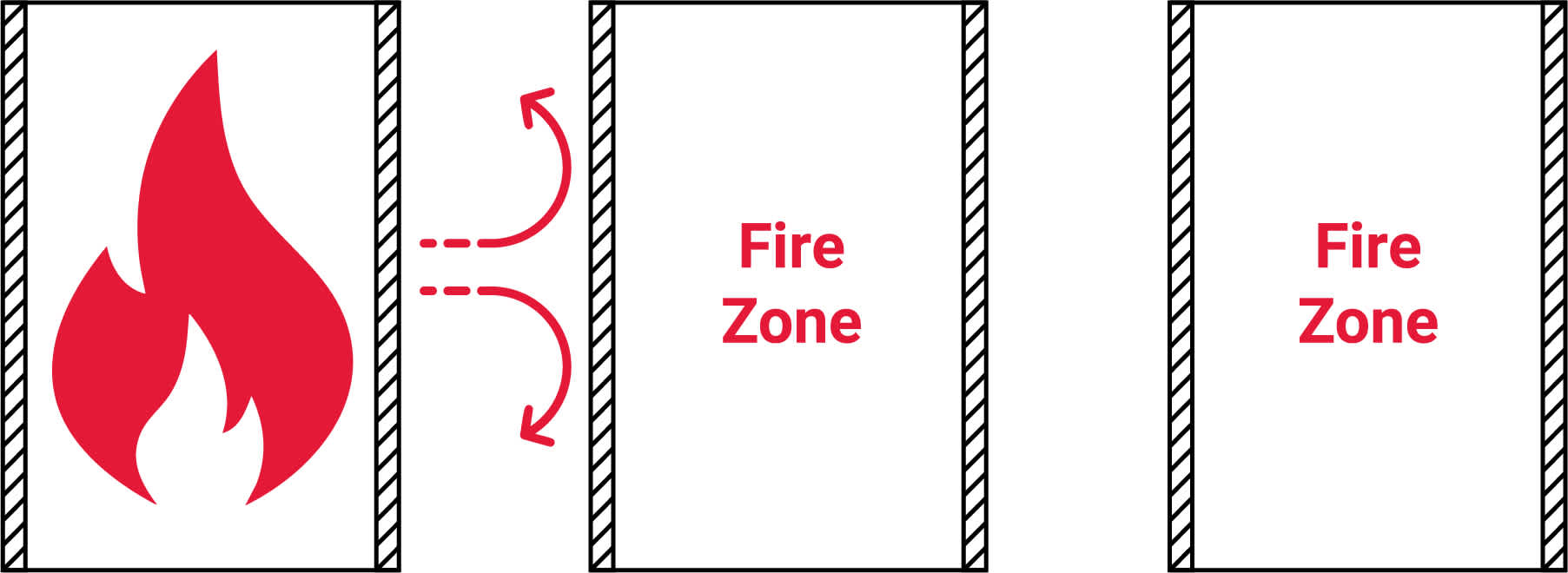
Compartmentation design divides the building into smaller zones. Each compartment has fire-resistant materials to create barriers that prevent fire from spreading to other parts of the building. However, there are areas that need particular attention and may require specialist fire-rated components, including doors, windows, ventilation ductwork and services that pass through compartment walls and floors.

Fire safety zones


Understanding fire to better control it

For effective fire protection, it is important to understand the life and behavior of fire, to limit life and minimize its effects. Fire needs three things – oxygen, heat and fuel.
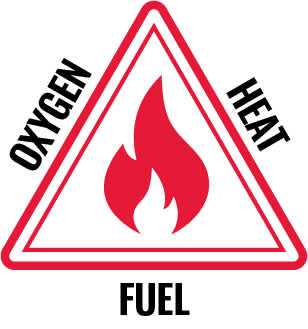
Oxygen heat fuel

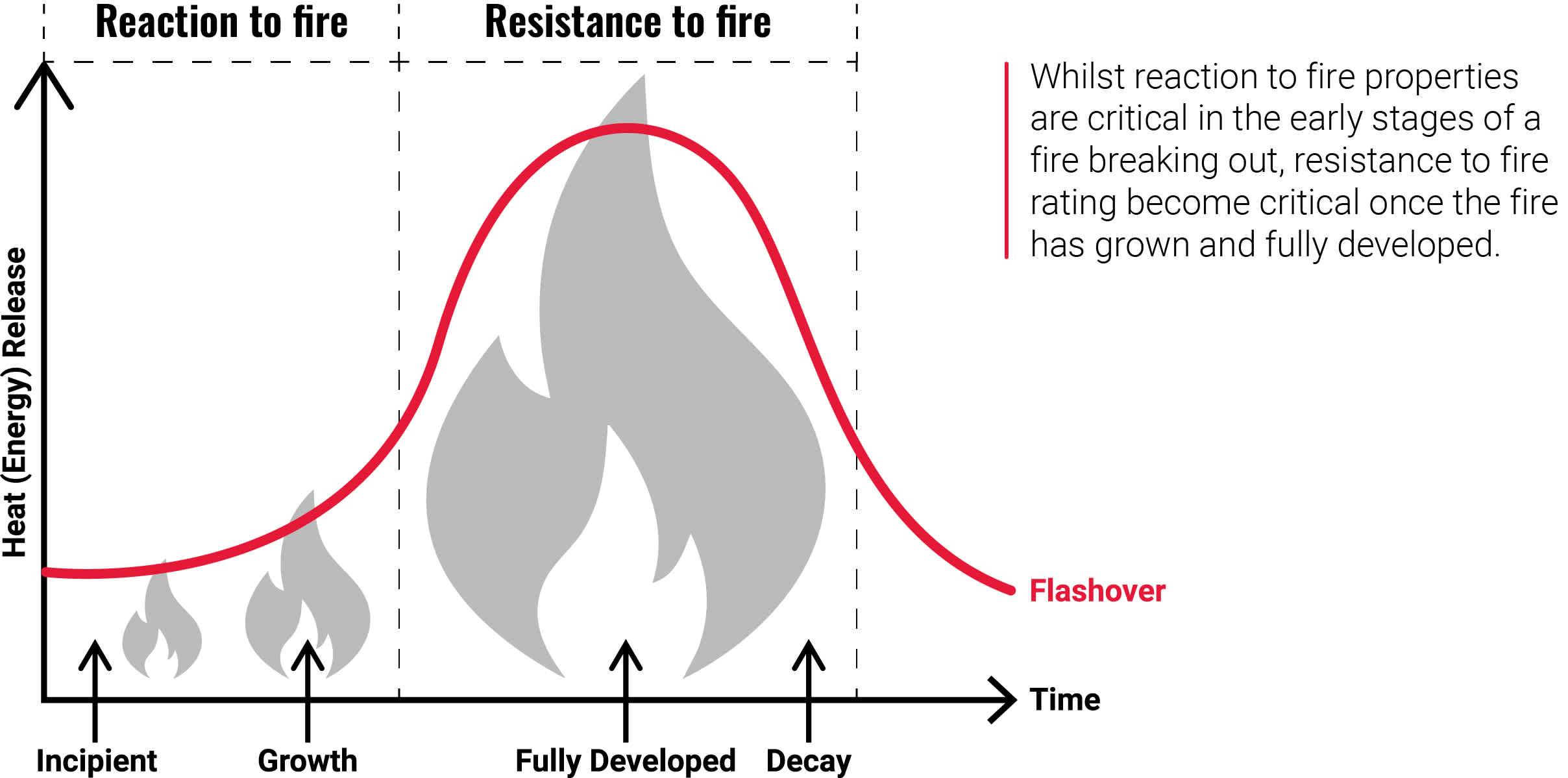
By limiting any element of the fire triangle (heat, fuel and oxygen) the fire can be contained more easily, protecting the building and everyone in it. When all these three things are abundant, fire tends to follow a pattern - ignition, growth, fully developed and finally decay.

Reaction and resistance to fire

The aim of fire protection is to prevent fire from growing and becoming fully developed. At this stage, it creates the most damage and poses the highest risk to structural integrity and overall safety. Therefore, it is important to understand that gases released in the early stages of a fire can become fuel for a growing fire.

Even with fire compartmentation and fire zones, it is crucial to limit the fuel, heat and oxygen. Choosing fire-resistant properties will help reduce the fuel available. In HVAC systems, fire-resistant ductwork and insulation can help maintain fire compartmentation and prevent feeding the fire with extra fuel.

Choosing the most suitable materials based on reaction to fire & resistance to fire

As the chart above shows, choosing materials that can resist fire at all stages is important.

To raise safety levels and enable comparison and selection from a fire safety perspective, all construction products, materials and building elements are classified by their reaction to fire. This is done in accordance with the Euroclass fire rating system under standard EN 13501-1. It categorises materials into different classes, from A1 to F, based on the materials behavior in the early stages of a fire. The Euroclass system addresses reaction to fire based on three aspects: combustibility, smoke and flaming droplets. 

It is important to note that the Euroclass system only addresses reaction to fire and does not describe performance over time during fire exposure. 

Reaction to fire testing methodology

The ‘Reaction to Fire’ testing measures a material’s contribution to fire. Different materials require different test methods to determine their reaction to fire classification, in accordance with EN 13501-1. 

For classes A2, B, C and D, reaction to fire is determined using the SBI test (Single Burning Item) according to EN 13823. This test evaluates a material’s contribution to fire growth and smoke production. Heat contribution is assessed by Fire Growth Rate (FIGRA), and smoke production is assessed by Smoke Growth Rate (SMOGRA).

For materials classified as A1, classification are based on non-combustibility criteria, rather than testing of fire growth and smoke production. 


The Euroclass system 

Euroclass includes seven ratings: A1, A2, B, C, D, E and F. Stone wool is a non-combustible insulation material that meets the highest fire classification for building materials, A1, according to EN 13501-1. This means that it does not contribute to fire development or spread and does not produce significant amounts of smoke or flaming droplets. Stone wool has a high melting point of over 1,000 °C* (*Internal test method).

A1

Non-combustible materials.

A2

Limited combustibility/non-combustible (depending on local legislation). 

B

Combustible materials. Very limited contribution to fire.

C

Combustible materials. Limited contribution to fire.

D

Combustible materials. Medium contribution to fire.

E

Combustible materials. High contribution to fire.

F

Combustible materials. Easily flammable.

For ratings A2-D, an additional class for smoke (s) and burning droplets (d) is also specified:

  • s1–s3 – smoke production (low to high) 
  • d0–d2 – burning droplets (none to high occurrence) 

An example product classification would be: A2-s1,d0

The Euroclass system is used for technical comparison of construction materials and, where applicable, forms part of the information for CE marking under the Construction Products Regulation ((EU) No 305/2011, CPR).  


Resistance to fire - performance over time 

While Euroclass describes reaction to fire in the early stages, fire resistance describes how long a construction, building element, or installation can withstand fire exposure over time. Fire resistance is classified according to EN 13501-2, and is based on the core criteria are:

R (Load-bearing capacity): how long the material supports weight during a fire.

E (Integrity): the material's ability to prevent the passage of fire and hot gases into unaffected areas.

I (Insulation): the material's capacity to prevent temperature increases on sides not directly exposed to fire.

Together, these form the REI classification. In addition to the core criteria, additional criteria may apply to specific performance requirements, for example:

S (Smoke): Airtightness and the prevention of smoke affecting other areas.

For the full list, refer to EN 13501-2.

Verified through standardised tests  

Fire resistance is verified through standardised fire tests in which building elements and systems are exposed to controlled fire conditions for a defined period. 

During testing, thermocouples, thermoelectric devices which measure temperature, are placed on specific areas according to the product’s appropriate testing standard. Temperature measurements are used to verify compliance with the insulation (I) criterion: 

  • no individual thermocouple may exceed 180 °Celsius above ambient temperature 
  • the average temperature rise of specified thermocouples may not exceed 140 °Celsius 

At the same time, integrity (E) is verified by ensuring that flames and hot gases do not pass through to the non-fire-exposed side. 

Fire resistance is expressed as an EI classification with a time designation, for example EI 30, EI 60 or EI 120, indicating the duration for which both integrity and insulation requirements are met during testing. For example, a product with an EI 30 rating did not exceed 180 degrees during testing and maintained an average lower than 140 degrees and maintained integrity for at least 30 minutes. EI 60 for 60 minutes, EI 120 for 120 minutes. 

Resistance to fire testing of ventilation ducts

EN 1336-1 standard

In fire resistance testing of ventilation ducts, different fire exposure scenarios are used to reflect real life conditions. Ventilation and air conditioning ducts are tested for fire resistance in accordance with EN 1366-1 and classified according to EN 13501-3. 

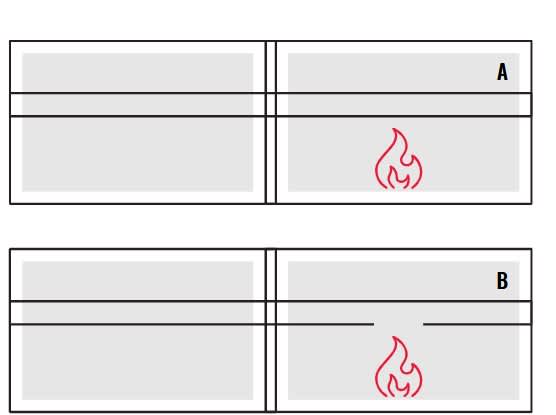
Testing may be performed with fire exposure outside the duct (o→i) or inside the duct (i→o), as fires can originate either in the surrounding space or within the ventilation system itself. Tests are also carried out in both vertical (ve) and horizontal (ho) orientations, as duct behaviour may differ depending on installation direction. 

The test evaluates the duct’s ability to maintain integrity (E) and insulation (I) when exposed to fire under defined conditions. Fire resistance testing is carried out according to two scenarios: 

  • A External Fire (o->i; channel A)
  • B Internal Fire (i->o; channel B)

Tests are performed in both horizontal (ho) and vertical orientations (ve), and in combination with standard firerated walls and floors: plasterboard, masonry, lightweight (aerated) and heavy(solid, cast) concrete.

Four fire tests required for a complete fire rating.

A complete classification, for example EI 60 (ve, ho, i↔o) S.

This shows that the duct system has been tested in both vertical and horizontal orientations, with fire exposure from both inside and outside the duct, and meets the additional smoke leakage criterion (S). 

Resistance to fire testing of ventilation ducts according to EN1366-1

The importance of fire-resistant insulation

As these classifications show, insulation plays a vital role in limiting the effects of fire. Fire-resistant insulation not only helps to comply with fire safety regulations but also aids fire resilience by creating an effective thermal barrier. Choosing insulation with passive fire protection qualities will further boost fire safety.

By protecting and maintaining fire compartments and limiting the spread of fire by minimizing heat penetration, people have more time to evacuate. It also provides firefighters with greater opportunity to control and extinguish the fire, preventing widespread damage to the building, and limiting major renovation or repairs.


Why ventilation systems are critical to fire safety

HVAC ducts present a unique fire safety challenge. They must run through walls, floors and partitions to function. Therefore, they require careful consideration within fire safety and fire compartmentation plans. Inadequate insulation or structurally vulnerable HVAC systems could limit the effectiveness of fire protection measures in other parts of the building.

By using proper seals and fire-resistant materials, HVAC ducts can support fire safety by creating further barriers or compartments. Insulation that has a low reaction to fire will limit temperature increases and the spread of smoke, flames or hot gases to other areas of the buildings.

That is why proper fire protection for HVAC systems is critical.

Ventilation and Air Conditioning | Paroc Applications.

For more in‑depth guidance on fire protection in ventilation and air‑conditioning systems, including requirements for fire resistance, testing, and system solutions, please refer to Ventilation and Air Conditioning | Paroc Applications.

PAROC Vect System Overview


PAROC® Vect - quality that never compromises

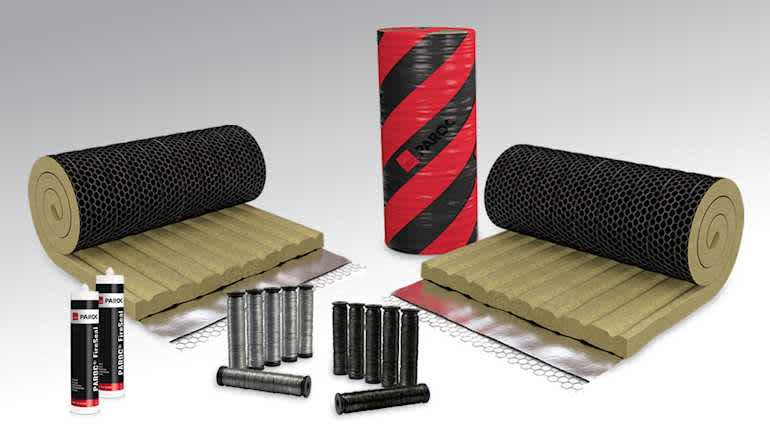
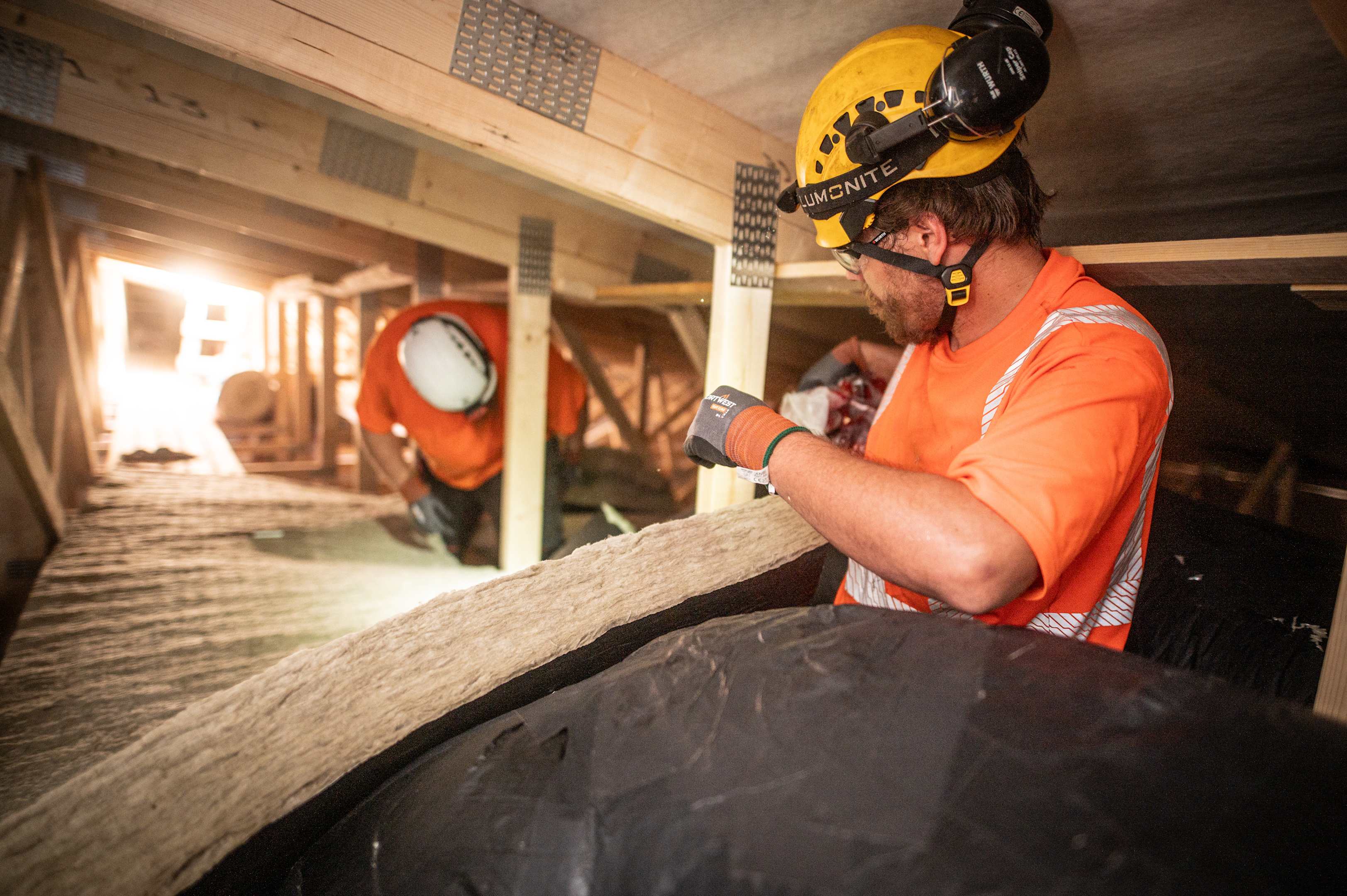
Owens Corning® PAROC® has developed the portfolio of passive fire protection solutions under the name of PAROC® VectThe non-combustible PAROC® Stonewool insulation materialdoes not burn, contribute to fire spread or produce smoke, helping to safeguard escape routes.

With the PAROC® Vect assortment, we are addressing the challenges that ventilation systems pose to fire safety. Our passive fire protection solutions for HVAC ventilation systems stand the test of time, protecting precious life.

Share this page on:

Related Articles

PAROC Vect Safe Spaces Header

Building Safer Spaces: Why Ventilation Insulation Matters in Schools and Daycares

Discover how proper insulation in ventilation systems enhances fire safety and indoor air quality in schools and daycares. Learn from Finland’s approach to building healthier, safer public spaces.
Read more
RnD Leader Melanie Aubert with PAROC Vect Mat

Engineering Excellence: The PAROC® Vect Development Journey

The PAROC® Vect portfolio required striking a delicate balance between regulatory compliance and real-world usability.
Read more
Paroc CGL 20 applied and painted to ceiling

Fire Regulations Determined the Insulation Choice for the Garage

PAROC CGL 20cy is cost-effective, easy to install, and visually appealing.
Read more